

RSRT and Reverta Join Forces to Advance Gene Therapy

I'm pleased to let the Rett community know about a new collaboration between RSRT and Reverta, a newly formed Italian biotechnology company developing a gene therapy for Rett syndrome.
Reverta Therapeutics was co-founded by Jeff Vick, who serves as CEO, and Vania Broccoli, PhD., who is affiliated with the San Rafaele Research Hospital and CNR, Chairman Carlo Bertozzi, and founding investor Extend which is Italy's National Technology Transfer Biotech Hub.
Dr. Broccoli has been studying Rett syndrome for many years. In 2020, his laboratory published an important paper in eLife describing a first-generation gene therapy approach for Rett using a delivery approach that reached the entire brain. That work was the first study to use an engineered viral capsid to reach more cells in the brain and, importantly, demonstrated safety and efficacy in male and female mouse models of Rett.
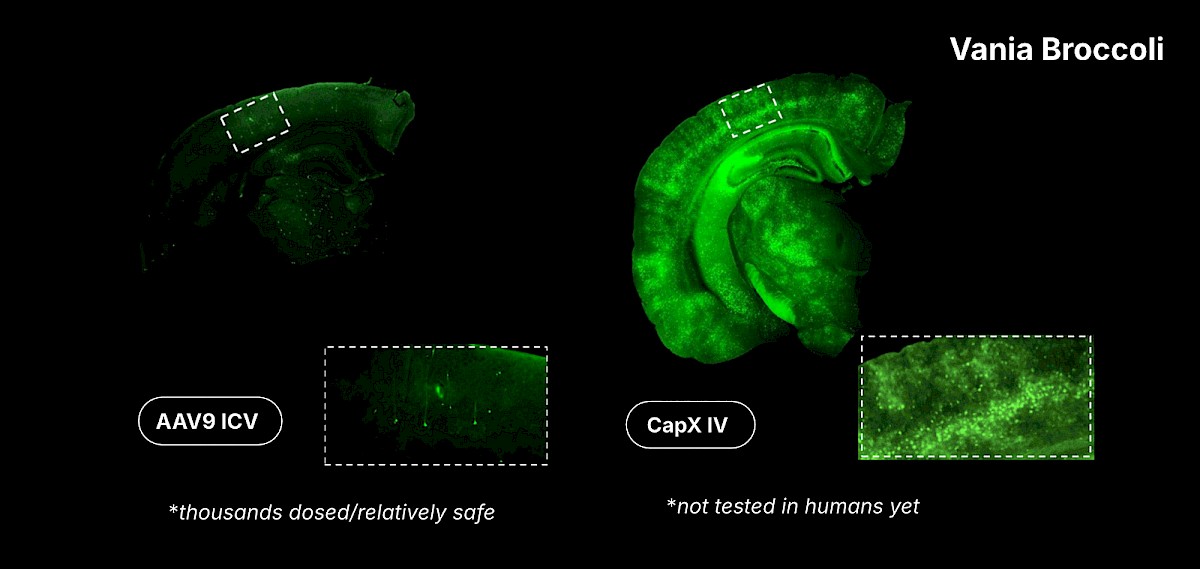
Previous gene therapy studies had used the natural adeno-associated virus AAV9, which reaches a limited number of cells in the adult brain when delivered intravenously or into the cerebrospinal fluid. The consensus in the field, however, was clear: reach more cells, get more improvement. To achieve broad distribution in the brain, the Broccoli lab used a newly evolved viral capsid developed in Viviana Gradinaru's lab called PHP.eB, which was capable of reaching more than 50% of cells in the brain by intravenous dosing. A major limitation, however, was that PHP.eB only worked in mice, because the receptor that allowed it to cross the blood-brain barrier isn't present in humans.
The new cargo at the heart of Reverta's program is designed to work with a new generation of gene delivery tools that didn't exist when the earlier work was done. Ben Deverman, a co-author on the 2020 paper, developed a new capsid called CapX that binds to the human transferrin receptor and in pre-clinical studies outperforms the tool virus used in 2020. Dr. Broccoli and his colleagues engineered their current gene therapy to specifically work with CapX.
Our community may remember that RSRT has a licensing agreement from Apertura Gene Therapy to access CapX.
The Science: What Makes This Approach Different
Developing a gene therapy for Rett syndrome is not straightforward. MECP2, the protein that is missing or dysfunctional in Rett patients, has to be expressed at precisely the right level. Too little causes Rett syndrome and too much causes MECP2 duplication syndrome. Furthermore, neurons in the brain naturally express more MECP2 than other cell types, like astrocytes.
Reverta's new gene therapy cargo is specifically designed to address two critical challenges in MECP2 gene therapy.
The first is preventing over-expression, especially in cells that are unaffected. Because Rett primarily affects girls who carry one working and one mutated copy of MECP2, not every cell in the brain needs therapeutic intervention. A blunt approach that delivers the gene everywhere equally risks giving healthy cells too much MECP2, with potentially serious consequences.
The second challenge is matching the natural variation in MECP2 levels across different cell types. Reverta's cargo is designed to reflect this natural biology, rather than applying a one-size-fits-all level of expression across the brain.
These are not small refinements. They represent a fundamentally more sophisticated approach, built on years of hard lessons, a deepening understanding of MECP2 biology and recognizing the need for brain-wide delivery.
Using a Delivery System Designed for the Brain
Even the best gene therapy cargo is only useful if it can reach its destination. Getting a therapy into every relevant region of the brain has historically been one of the biggest obstacles in neurological gene therapy.
That is where Apertura Gene Therapy's CapX capsid comes in. As we highlighted when RSRT obtained a non-exclusive license to CapX, it is an engineered AAV capsid designed to cross the blood-brain barrier after a simple intravenous infusion. It does this by targeting the human transferrin receptor, a protein naturally present on the blood vessels of the brain that the capsid uses as a molecular doorway, resulting in brain-wide delivery.
CapX has not been tested in people yet, but it is on a trajectory that the broader field is watching closely, with clinical use in other diseases anticipated later this year or early 2027. Pairing this next-generation delivery vehicle with Reverta's carefully engineered cargo creates a combination that wasn't possible just a few years ago, and is why this moment feels different.
What RSRT's Investment Makes Possible
The collaboration between RSRT and Reverta will initially focus on a critical and often underappreciated phase of gene therapy development: manufacturing.
Even when the science is next-level, producing a gene therapy reliably, at sufficient scale, and to the quality standards required for clinical trials is an enormous technical challenge. It requires specialized expertise and facilities, and a methodical process of optimization.
RSRT is funding $1.1 million in manufacturing work at Viralgen, a world-class contract development and manufacturing organization (CDMO) with deep expertise in AAV gene therapies. The work will involve producing progressively larger batches of the therapy combining CapX with Reverta's gene cassette, with each run designed to refine and optimize the process. The goal is to establish a manufacturing process that is robust, reproducible, and capable of producing clinical-grade material -- the quality standard required before a therapy can be tested in human trials.
This kind of work doesn't produce new papers and isn't going to make headlines. But there are no patient cohorts, no efficacy readouts, and no dramatic before-and-after moments until a therapy can be reliably manufactured. Beyond the Reverta program, this manufacturing work, funded directly by RSRT, will generate important information for any program that uses CapX to deliver genetic medicines for Rett syndrome, making it an investment in the field as a whole.
The science has never been more promising. The tools have never been better matched to the problem. And RSRT is committed to doing the hard, unglamorous work that bridges the gap between what is possible in the laboratory and what is required to treat patients. Stay tuned for updates.