

Six Years of Partnership: How RSRT and Citizen Health Are Accelerating Rett Research
For the past six years, RSRT and Citizen Health have worked together to accelerate the development of genetic medicines for Rett syndrome.
For the past six years, RSRT and Citizen Health have worked together to accelerate the development of genetic medicines for Rett syndrome. By combining RSRT's expertise in Rett syndrome and connection with the family community with Citizen Health's innovative approach to securely collecting and organizing healthcare data, this partnership aims to help industry better understand the disorder and design more efficient and expedient clinical trials.
Why does this matter?
To develop new treatments for Rett syndrome and other rare disorders, researchers need to understand two things: how the disease changes over time and what meaningful improvement would look like if a treatment works. That information, known as natural history data, is the foundation of every clinical trial.
Natural history data provides a detailed picture of how Rett syndrome progresses, both in individual patients and across the broader Rett community. When collected rigorously, this information helps scientists:
• Recognize when a treatment is working, sometimes earlier than would otherwise be possible.
• Design more efficient clinical trials with less burden on families.
• Move more quickly toward FDA approval and patient access.
Natural history data has already changed how rare disease trials work. In some cases, it removes the need for a placebo (untreated) comparison group, because researchers already know what the expected course of the disease looks like without treatment. It also helps identify which specific developmental milestones are the most meaningful signs that a treatment is working. Two ongoing Rett gene therapy programs, from Neurogene and Taysha, are relying on the NIH's traditional Rett natural history study to define exactly these kinds of milestones. The FDA has agreed that improvements in these milestones could support approval of the gene therapies.
A Faster, Fully Remote Approach
In 2020, as COVID-19 was closing down in-person Rett clinic visits worldwide, RSRT and Citizen Health launched a new kind of natural history study — one that could be done entirely from home. With a caregiver's permission, the study retrieves relevant information directly from a patient's existing medical records, with no clinic visits required.
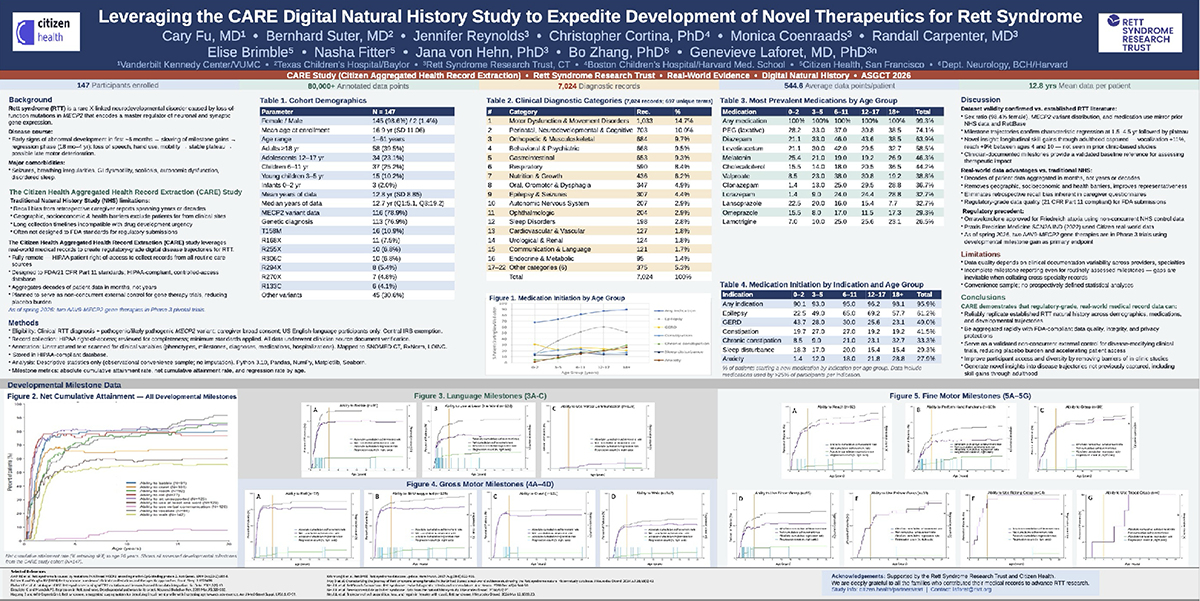
This effort, called the CARE Study (Citizen Health Aggregated Health Record Extraction), has now collected and analyzed data from 147 Rett patient medical records, with more on the way. Early findings were presented at the 2026 American Society of Gene & Cell Therapy conference and will soon be submitted to a peer-reviewed scientific journal.
Why This Is a Big Deal
Traditional natural history studies typically require years of in-person visits. The CARE Study shows that carefully extracting information already sitting in medical records can gather and analyze years' worth of rare disease data in a matter of weeks — at a fraction of the cost, and from a broader, more diverse group of participants across more locations.
Faster, more representative data means faster and more robust clinical trials, and earlier access to new treatments for the families who need them. Forward-thinking initiatives like this one are central to RSRT's mission of advancing genetic medicines to cure Rett syndrome.
You Can Help
The CARE digital natural history study is open for participation for US families.
If you consent to participate, Citizen Health handles the rest — retrieving your loved one's medical records on your behalf. No further action is needed from you.
The CARE Study welcomes anyone in the US with a clinical diagnosis of Rett confirmed with a genetic mutation in MECP2.
Thank you for helping move Rett research forward.