

C-Terminal Deletions: Two Endings, Two Very Different Outcomes
Why some C-terminal deletions in MeCP2 cause Rett syndrome, and others don't.

This is the story behind our recently published paper, which asked a simple question: why do some C-terminal deletions in MeCP2 cause Rett syndrome, while others don't?
Think of a protein as a long chain of building blocks (amino acids) strung together, like beads on a string. That chain has two ends, the start is called the "N-terminus" and the end is the "C-terminus". A C-terminal deletion means a section of the protein is missing from the end.
After many years of designing and producing mouse models of MECP2 mutations, work supported throughout by RSRT, I first became interested in C-terminal deletions (CTDs) around 2012. At that time, two particularly important regions of the MeCP2 protein had been identified. One, called the methyl-CpG binding domain (MBD), allows MeCP2 to bind to DNA. The other, the NCoR-interacting domain (NID), allows MeCP2 to recruit a group of other proteins that help regulate the activity of genes.
This raised an interesting question. Were these the only parts of MeCP2 that were essential for its function, or were there other important parts of the protein that we had yet to discover? To investigate this, we looked at Rett syndrome mutations that don't affect either the MBD or the NID. If MeCP2 could still function when these other parts were altered, that would suggest that the MBD and NID might indeed contain everything that was essential for its function. CTDs were among the mutations we investigated.
Interestingly, another project that grew out of this work led to the development of the MeCP2 "minigene", a shortened version of the gene containing only the parts needed to produce a functional MeCP2 protein. This is now being used by Taysha in their gene replacement therapy program.
A spelling mistake, or a missing letter
The Rett syndrome mutations that were well studied at the time were mostly very simple changes in the MECP2 gene. You can think of these as being a little like a spelling mistake in a set of instructions. Our DNA is made up of four chemical "letters", G, A, T and C. Sometimes a single letter is changed to another letter. This can alter the instructions for adding one of the building blocks of the MeCP2 protein, called an amino acid. If the change occurs in an important part of the protein, the resulting MeCP2 may not work properly. Examples of these so-called "point mutations" include R133C, T158M and R306C.
CTDs are quite different. Rather than changing a single letter in the genetic instructions, they remove one or more of these letters from the DNA in a region near the end of MECP2, after the known functional domains. The exact number of letters removed determines what happens to the resulting protein.
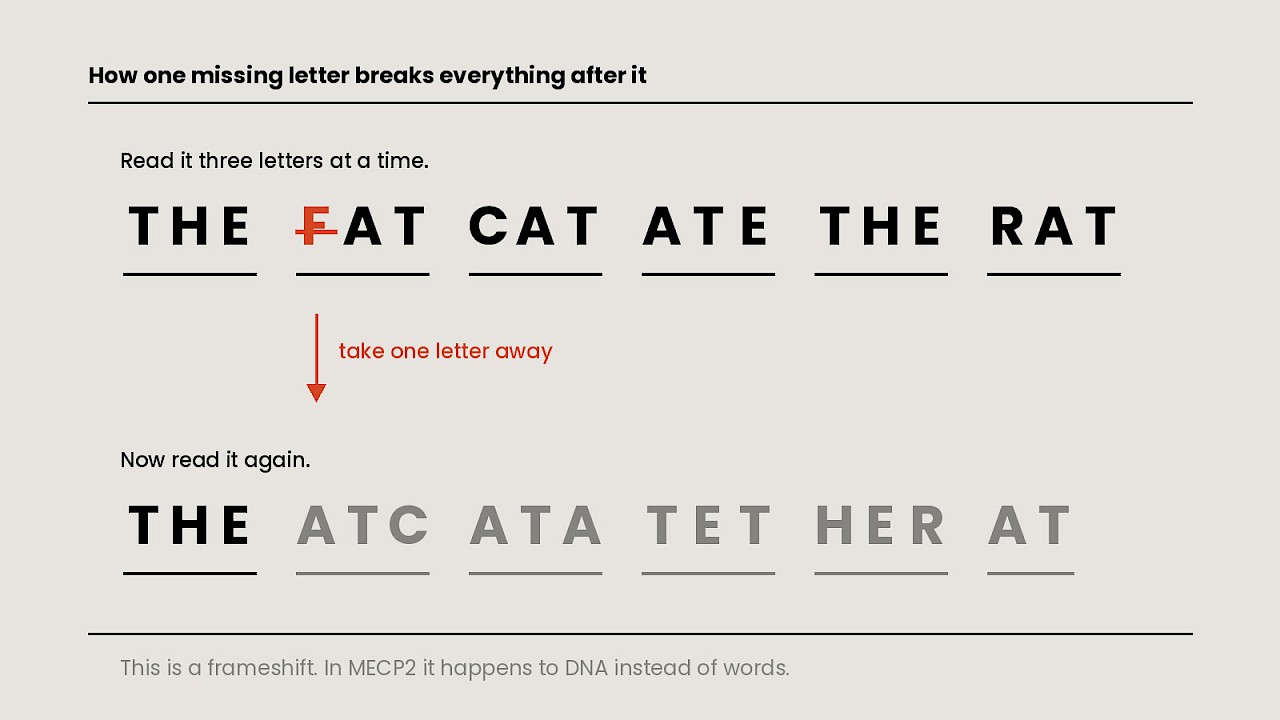
Three DNA "letters" are used to specify each amino acid in a protein. So, if the number of letters deleted is a multiple of three, some amino acids will simply be missing, but the remaining genetic instructions stay in the correct reading frame and the protein can continue to its normal end. Losing a few amino acids from this part of MeCP2 doesn't seem to affect its function. These are called "in-frame" deletions and they don't cause Rett syndrome.
But if the number of letters deleted is not a multiple of three, something much more dramatic happens. This is called a frameshift. From the point of the deletion onwards, the three-letter groups are thrown out of alignment, meaning that all the subsequent amino acids will be different. Eventually, the altered sequence encounters a signal telling the cell to stop making the protein. The normal C-terminal sequence is therefore replaced by a shortened abnormal sequence at the end of the MeCP2 protein.
Two mutations that look the same
You might think that simply losing this part of the protein is the thing that stops MeCP2 from working, but this is where things get interesting. Not all of these frameshift CTDs cause Rett syndrome, even though they produce very similar-looking changes to the MeCP2 protein.
We looked at MECP2 mutations in two large databases containing human genetic information. As expected, we found many frameshift CTDs in RettBASE, a database containing mutations found in people with Rett syndrome. But we were intrigued to find similar-looking mutations in gnomAD, a much larger database containing genetic information from people who are not known to have a genetic disease. Why should apparently similar changes have such dramatically different consequences?
To cut a long story short, using data from people and experiments with mouse models, we discovered that the answer lay in exactly what happened at the very end of the shortened MeCP2 protein.
Remember that the number of DNA letters deleted determines how the three-letter reading frame is shifted. We found that there were two possible outcomes. Some deletions produce a new ending containing the amino acids SPRTX. These proteins were produced in normal amounts and, importantly, did not cause Rett syndrome. Other deletions produce a different ending, containing PPX. These were the CTDs associated with Rett syndrome.
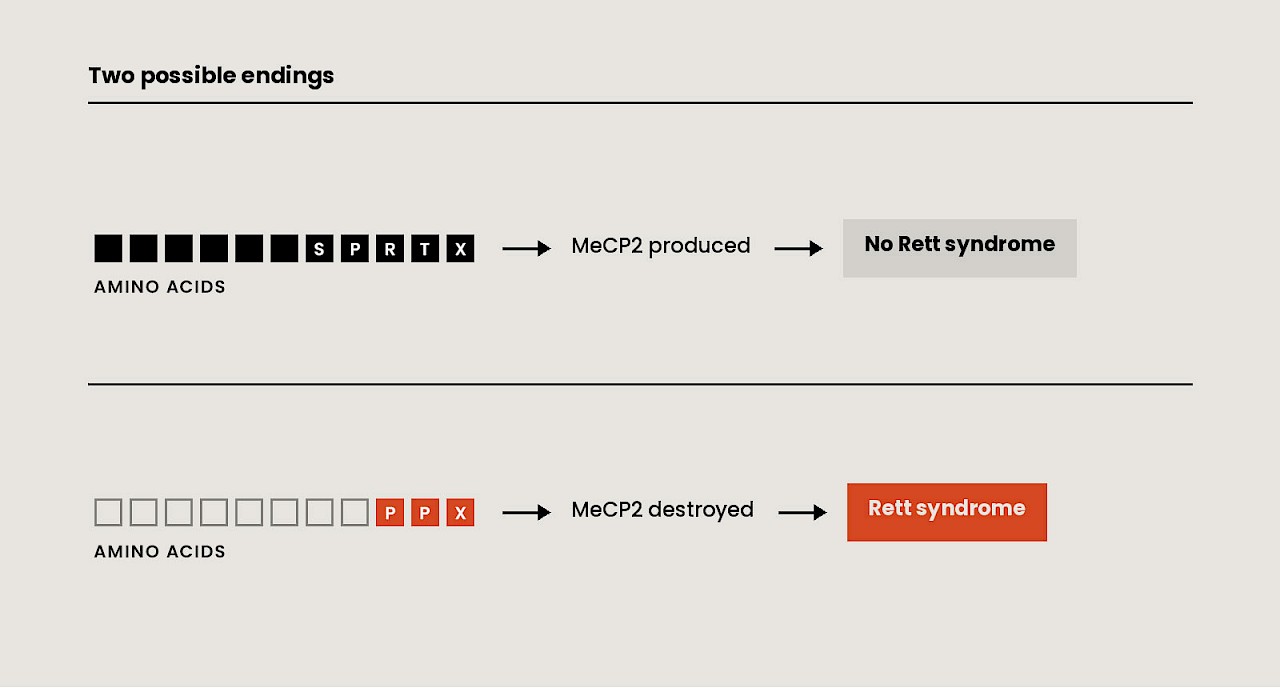
Why should changing just a few amino acids at the very end make such a difference? Our mouse experiments provided the answer. The PPX ending acts like a signal telling the cell to destroy the shortened MeCP2 protein. As a result, very little of the protein remains, leaving the cells without enough functional MeCP2 to do its job.
So, the surprising conclusion was that the missing part of MeCP2 wasn't itself the problem. Instead, what was added to the end of the protein as a consequence of the frameshift determined whether the protein survived or was destroyed.
Why does this matter for families?
This distinction isn't just important for understanding the biology. It can matter enormously when a CTD is found during genetic testing.
In our paper, we describe a family in which a CTD was identified during prenatal testing of a daughter. At first, the result raised concern because this kind of mutation had previously been associated with Rett syndrome. However, further investigation showed that the same mutation was present in several healthy family members, including her father.
We were able to explain why. This particular deletion produced the benign SPRTX ending rather than the disease-associated PPX ending. The shortened MeCP2 protein was therefore produced in normal amounts and could still function.
With ever increasing amounts of pre- and neonatal genetic testing being carried out, it is important to understand which mutations are likely to be benign and which are pathogenic. This allows clinicians and genetic counselors to give families the best possible information about what a genetic finding is likely to mean.
Could we use this discovery to treat Rett syndrome?
The final part of our study cycles back to those individuals with a Rett syndrome-causing CTD and concerns the development of a potential genetic therapy that could help this whole class of patients, which accounts for approximately 10% of Rett syndrome cases.
We reasoned that if it was just the PPX ending that caused the problem, what if we could edit the mutated DNA, changing just one letter so that the protein no longer stopped after the "PP" sequence? The protein would then have a different ending and, we hoped, would no longer be destroyed.
We tested this by making this change in a mouse and, sure enough, the MeCP2 protein was no longer destroyed and the mouse was healthy.
Spurred on by this result, we have developed a strategy to make the same type change using an adenine base editor (ABE), a type of genetic editing technology first developed by David Liu and based on CRISPR/Cas technology. Unlike conventional CRISPR editing, base editors can make a precise change to a single DNA letter without cutting both strands of the DNA.
Here, we have published our work using this approach in cultured cells and are currently testing the technology by delivering it to the mouse brain.
There is still a long way to go before this could become a treatment for people with Rett syndrome. We will need to demonstrate that the editing can be delivered efficiently to the right cells, that it is safe, and that it restores a sufficient amount of functional MeCP2 in the brain.
But the fact that a single-letter change can rescue the MeCP2 protein in our mouse model gives us a potential way of tackling a whole class of Rett syndrome mutations that, until now, we had thought were simply caused by losing the end of the protein.
Jacky Guy is a research scientist in Adrian Bird's laboratory at the University of Edinburgh, where she was first author on the 2007 study demonstrating that Rett syndrome symptoms can be reversed in mice. The Bird Lab has received consistent funding from RSRT for almost 20 years.